The Whole Child
More Than Movement
Parents often think of dance as a creative outlet or a physical activity. It's both — but the research shows it's also one of the most effective tools for developing your child's brain, body, and character.
Studies published in Frontiers in Psychology, the New England Journal of Medicine, and by leading researchers at Harvard confirm that dance engages the motor cortex, cerebellum, and hippocampus simultaneously — a "full-brain workout" unlike almost any other childhood activity.
Research-Backed Benefits
What Dance Does for Your Child
Every benefit below is grounded in published research. Dance is not just an art form — it's one of the most complete developmental tools available to children.
Learning choreography activates the hippocampus (memory), motor cortex (movement), and prefrontal cortex (planning and focus) simultaneously. Research confirms that children who dance show faster cognitive processing, stronger attention spans, and improved problem-solving ability.
Dancing to music enhances auditory processing and rhythmic synchronization. Children learn to internalize beat, phrasing, and dynamics — skills proven to correlate with higher performance in reading, mathematics, and language arts. Musical intelligence developed through dance transfers directly to academic settings.
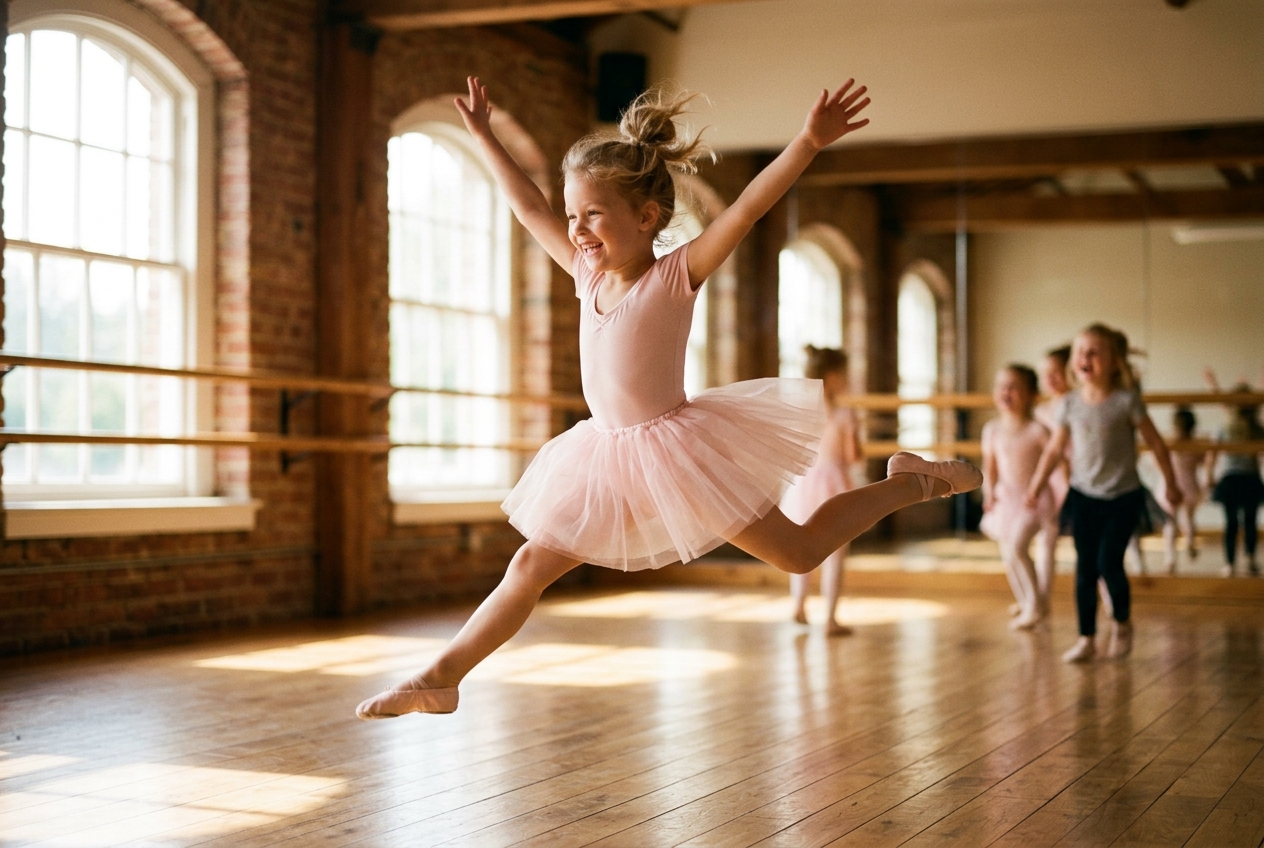
Through structured movement — leaping, balancing, turning — children develop both gross and fine motor skills. Studies show dance students demonstrate significantly improved balance, proprioception, and sensorimotor synchronization. These gains support everything from sports performance to everyday physical confidence.
Dance is one of the few activities that builds cardiovascular fitness, muscle strength, and flexibility without the high injury rates of contact sports. The American Heart Association recognizes dance as an excellent aerobic activity for children. It supports healthy weight, posture, and bone density — without unnecessary impact on developing joints.
Memorizing and performing sequences of steps is a cognitive exercise comparable to learning a second language. Regular dance practice strengthens working memory and long-term retention. Children who dance have been shown to retain information more effectively in academic settings and demonstrate superior concentration and mental stamina.
The process of learning, rehearsing, and performing builds genuine self-confidence — the kind that comes from earned accomplishment. Research from the University of Maryland and Santa Monica College confirms that dance students demonstrate higher self-esteem, emotional intelligence, and resilience. Performance experience teaches children how to handle pressure with poise.
Group classes and ensemble work develop cooperation, trust, empathy, and non-verbal communication. Children learn to listen, share space, and support one another — skills that carry directly into school and adult life. Dance studios create lasting friendships and a sense of belonging that is rare in other extracurricular activities.
Dance gives children a vocabulary for emotions they may not yet have words for. Creative movement fosters self-awareness, emotional regulation, and artistic identity. Research shows that children who regularly engage in creative arts demonstrate stronger empathy, greater problem-solving flexibility, and richer inner lives.
Dance training requires consistent practice, attention to detail, and the ability to receive and respond to correction. These habits — showing up, trying again, improving incrementally — build a work ethic that translates to academic achievement, career success, and personal resilience. Dance teaches children that excellence is earned, not given.
Beyond the Studio
Dance Opens Doors.
For dancers who choose to pursue their training seriously, dance becomes more than a passion — it becomes a competitive advantage. Top colleges and universities actively recruit talented dancers, and merit-based scholarships are available at hundreds of institutions.
Hundreds of accredited colleges and universities — from major research universities to conservatories — offer merit-based scholarships for dance. Renner Dance alumni have earned scholarships to the University of Arizona, Pace University, Florida State University, and more.
Programs like the UNC Carolina Girls, FSU Dance Team, and similar high-profile collegiate teams actively recruit technically trained dancers. Strong studio training is the primary differentiator in these auditions.
Competitive dancers have a clear pathway into some of America's most prestigious pre-professional programs, ballet academies, and performing arts conservatories — opening doors to professional company careers.
Renner Dance alumni have performed for Mariah Carey, choreographed for the Backstreet Boys, performed at the FIFA World Cup, and appeared in major films. A strong technical foundation opens opportunities that go far beyond traditional dance careers.
The Numbers
"Dance is the only art form in which the instrument and the artist are the same."
Give Your Child This Gift
Ready to Start the Journey?
Try your first class completely free. See the difference for yourself in just one visit.